A Proven GC–MS Platform for Growing Labs
Service AI
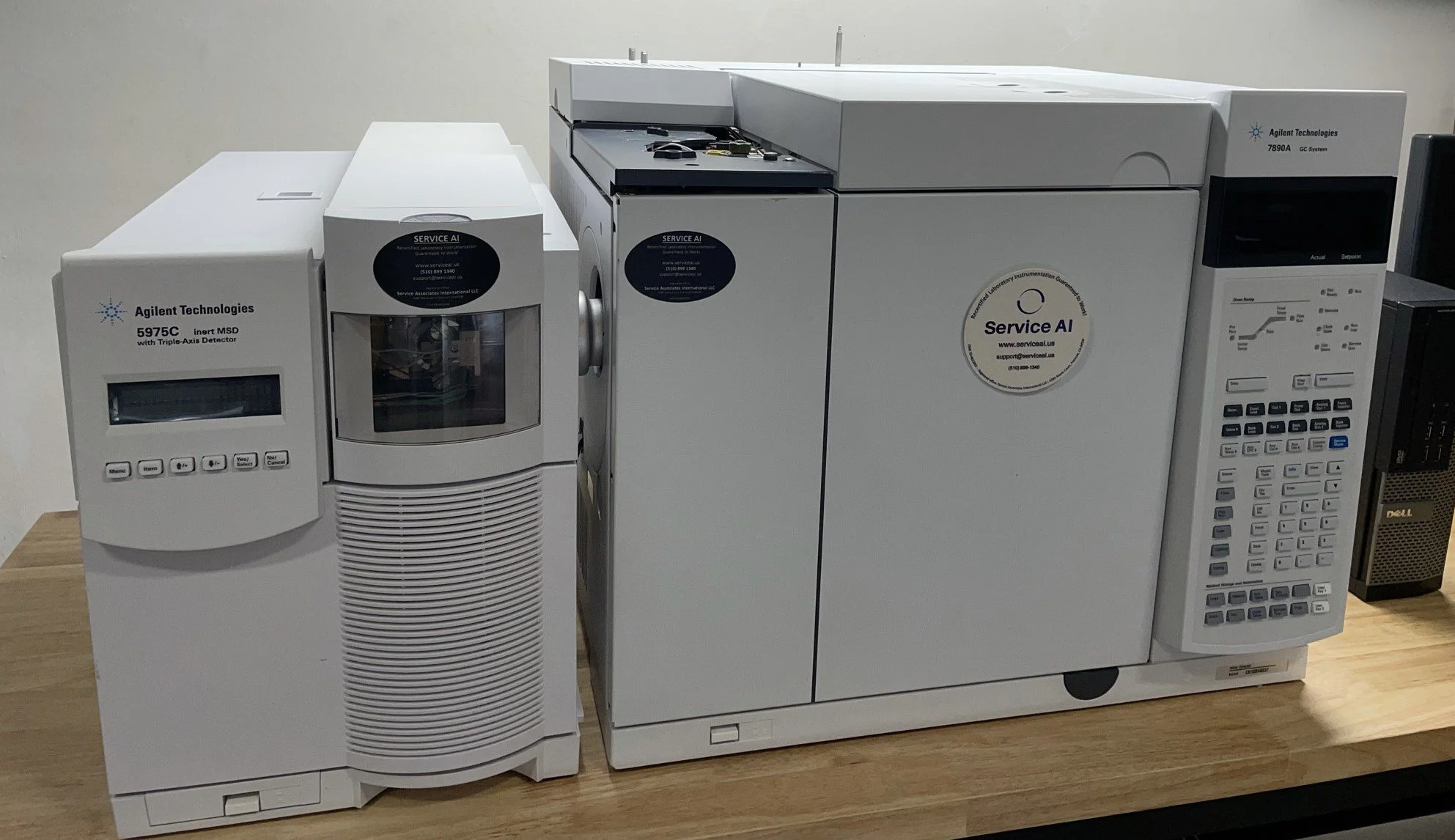
Agilent 5975C Inert MSD (G3171A) with 7890A GC and 7683B Autosampler
For start-ups and small testing labs, choosing a GC–MS isn’t just about buying hardware – it’s about adopting a platform with well-documented performance, standard methods, and a long track record in the scientific literature.
Service AI offers a refurbished Agilent 5975C Inert MSD (model G3171A, standard turbo EI), paired with an Agilent 7890A GC, 7683B autosampler with 100-vial tray, and MassHunter GC/MS Acquisition software (version B.07.03).
The Heart of the System: 5975C Inert MSD (G3171A)
The 5975C Inert MSD is part of Agilent’s 5975-series single-quadrupole GC–MS detectors, designed for routine and trace-level EI work across environmental, food, petrochemical, and forensic applications.
Agilent’s specifications for the 5975C series:
Inert EI source
The 5975C Inert MSD uses a non-coated inert electron-ionization (EI) source. This design is intended to reduce unwanted interactions with active and reactive compounds, helping preserve peak shape and response for challenging analytes.Triple-Axis HED Electron Multiplier
The detector is a Triple-Axis High Energy Dynode (HED) electron multiplier. Agilent specifies this geometry to improve signal-to-noise performance and extend detector lifetime, supporting trace-level detection in full-scan and SIM modes.Mass range and stability
The 5975C provides a mass range from about 1.6 to 1050 u, with mass axis stability on the order of 0.10 u over extended periods (typically specified over 48 hours). This supports library searches, quantitative methods, and long runs without frequent recalibration.Scan and SIM performance
The series is specified for fast scan acquisition (electronic scan rates in the tens of thousands of u/s) and SIM capability with multiple ions and groups, allowing both broad screening and targeted quantitation on the same platform.G3171A = standard turbo EI
Within the 5975C family, G3171A is the “standard turbo EI MSD” configuration: it operates in electron ionization mode with a turbo-molecular pump sized for typical capillary column flows used in GC–MS. Chemical ionization (CI) is available on other 5975C configurations with additional hardware, but this G3171A unit is correctly described as an EI-only, inert MSD with Triple-Axis detector.
Taken together, these characteristics describe a mainstream, single-quadrupole EI GC–MS detector that matches the conditions and performance assumptions behind many Agilent application notes and GC–MS methods.
Instrument Control: MassHunter GC/MS Acquisition B.07.03
With this system, Service AI supplies Agilent MassHunter GC/MS Acquisition software, version B.07.03, which is Agilent’s control and data-acquisition environment for 5975/5977-series MSDs.
In Agilent’s documentation, MassHunter GC/MS Acquisition B.07.x is used to:
Configure the GC and MSD parameters (inlets, oven programs, source and quadrupole temperatures, detector settings).
Build scan and SIM methods, schedule SIM groups, and set acquisition windows.
Run autotune routines, monitor tuning performance, and track system status.
Create and execute sample sequences, monitor chromatograms and mass traces in real time, and save data in a format compatible with downstream MassHunter or third-party processing tools.
Version B.07.03 also introduces user and audit-trail features that can be configured to support laboratories working under regulated data-integrity frameworks when combined with the appropriate Agilent data-management components. This same software line is widely used on Agilent GC–MS systems in research and testing labs and is cited in many peer-reviewed publications as the acquisition layer for 5975- and 7890-based workflows.
GC and Autosampler: Stable Chromatography, Automated Throughput
While the MSD is the centerpiece, the 7890A GC and 7683B autosampler are the workhorses that deliver stable chromatography and unattended operation:
The 7890A GC offers an oven range from near ambient up to 450 °C, programmable multi-step temperature ramps, and electronic pneumatic control (EPC) with fine pressure resolution. These features underpin reproducible retention times and straightforward method transfer from Agilent and peer-reviewed methods that specify 7890/5975-type systems.
The 7683B autosampler with vial tray can handle up to 100× 2 mL vials, supports a standard set of GC syringe sizes, and runs fully automated sequences with options for calibration standards, QC samples, and routine batches.
Why This Matters for Start-Ups and Small Testing Labs
Because the 5975C Inert MSD (G3171A) + 7890A GC + 7683B autosampler + MassHunter B.07.03 configuration is built entirely from standard Agilent components and software, it aligns with:
Agilent’s own GC–MS application notes and method collections
Many peer-reviewed GC–MS studies that specify 5975/7890 hardware and MassHunter software
For a new or growing lab, that means:
You are working on a well-documented, widely used platform.
You can adopt or adapt existing Agilent methods and literature procedures instead of starting from zero.
You have an instrument whose core performance and configuration are backed by vendor specifications and published use.
Service AI’s role is to refurbish, recertify, and install this platform so that environmental, food, petrochemical, and forensic start-ups can deploy an Agilent-defined GC–MS system with confidence in both the hardware and the data it produces.
